The Sensory Coach

Category: Aromatherapy

  • Shinrin Yoku – How to Ease Your Mind in the Forest
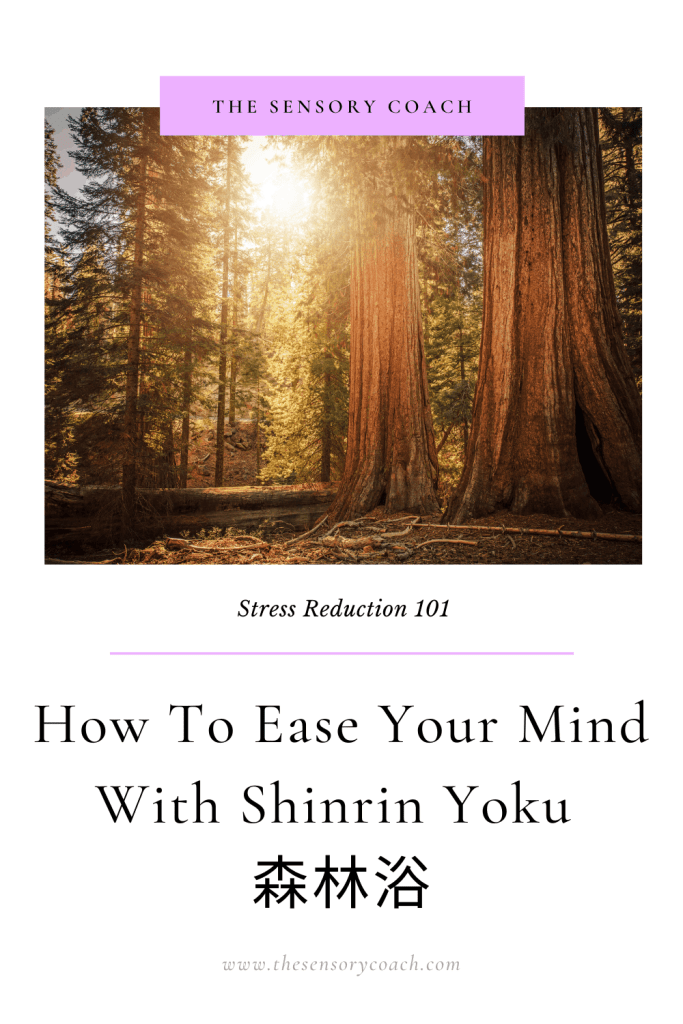
    Shinrin Yoku – How to Ease Your Mind in the Forest

    In this article we’ll be exploring the many  wonders of Shinrin Yoku and discovering how to ease your mind in the forest.

    How to ease your mind with Shinrin Yoku TheSensoryCoach.com

    What Is Shinrin Yoku?

    Shinrin Yoku is the Japanese healing art of Forest Bathing.

    Forest Bathing doesn’t mean you need to go and find a bath to jump into in the middle of the woods! Although there are some incredible options available if bathing under the stars appeals to you.

    Forest Bathing is a holistic therapy that involves spending 2 – 4 hours in the forest, simply being with the trees.

    It’s a gentle therapy, that involves experiencing the woodland through all your senses. 

    How to ease your mind with Shinrin Yoku TheSensoryCoach.com

    How Do You Pronounce Shinrin Yoku?

    Shin – din – yock – ooh is how the Japanese say Shinrin Yoku, but English speakers tend to say either shin – rin – yock – ooh or shin- rin -yo-coo.

    The Shinrin Yoku Kanji

    Kanji are the symbols that are used to form Japanese writing. The Shinrin Yoku symbol, or kanji,  looks like this:

    森林浴

    What Are The Benefits of Forest Bathing?

    The benefits of Shinrin Yoku are quite astonishing. Research from Japan has shown that long-standing health improvements are possible, even from just a couple of hours spent with the trees.

    What is quite incredible, is that these health benefits continue long after you’ve left the forest. Indeed, research shows that these effects can last for as long as 30 days!

    These health benefits include a significant reduction in cortisol levels (our primary stress hormone), along with improvements in the functioning of the immune, cardiovascular, and respiratory systems.

    In real terms, this can look like a reduction in blood pressure, an increase in natural killer cells (important for fighting off viruses and tumour cells), and even improvements in COPD.

    Along with the improvements to our physical health, forest bathing has also been shown to significantly reduce symptoms of depression too.

    Trees and Depression

    When our bodies feel better, our minds tend to feel better too.

    But it’s not simply the physical improvements that create a sense of being uplifted by time in the forest.

    The psychological effects of trees on humans are enormous. 

    For instance, it’s been shown that tree-lined streets have a role to play in crime reduction.

    This is in part due to the calming influence trees have on humans.

    Trees provided sanctuary, food, warmth, medicine, and play for our ancestors. Even with all of our modern technology, we still have a deeply wired, evolutionary connection with the forest.

    With so many of us living without easy access to woods and forests, this aspect of our evolutionary psychology remains unfulfilled and maybe fuelling our burgeoning mental health issues. 

    How to Ease Your Mind When You Don’t Live Near Trees

    Whilst we may be unaware that we yearn for contact with trees (especially if we’ve never had the experience of spending much, if any, time in the woods) our bodies and souls crave that connection with nature.

    Nothing beats time spent with living, breathing trees, but there are ways to bring the forest indoors that have both psychological and physiological benefits. 

    Care For Plants

    The easiest way to bring an immediate sense of nature to our environment is by buying a few plants.

    Whilst studies have shown that it’s a myth that house plants improve indoor air quality, having natural greenery to rest our eyes on can have a calming effect.

    Talking to plants is great for their health, and expressing our feelings verbally is great for ours too, so make sure to have a regular chat with your green friends!

    Having a living plant to take care of can also remind us to take better care of ourselves.  Life can feel less futile when we know another living being depends on us. Why not consider plants as pets?

    Decorate with Forest Colours

    in 2017, Pantone named their colour palette Forest Bathing. No doubt designers everywhere rushed out to bring the forest into their client’s homes that year. Take a …. leaf out of their book… and utilise paints, murals and natural images to create a sense of the forest in your living space.

    pantone forest bathing swatch The Sensory Coach Shinrin Yoku How To Ease Your Mind In the Forest

    Meditation and Sound Healing

    It’s well known that meditation and sound healing both have numerous beneficial impacts on our health and well being. Why not combine the two and add a dose of nature for good measure?

    This is exactly what I did when I created my woodland meditation with binaural beats. Recorded in the woods behind my home, at the start of the UK lockdown in March 2020,  the birdsong is wonderfully melodious and vibrant.

    Closing your eyes and picturing yourself wandering through the forest, birds singing and beck babbling, instantly transports you into nature, even in the hustle and bustle of the city.

    Use Japanese Forest Bathing Essential Oils

    As an aromatherapist, one of the most exciting things about the Shinrin Yoku research, is that it shows that tree essential oils work almost as well as spending time in the forest.

    It’s been shown that Hinoki essential oil has the most Shinrin Yoku like effect on human physiology.

    This is why you will find it is the main ingredient in my Spirit of Shinrin Yoku essential oil blend. 

    When you are unable to get to a forest, this is the next best thing for body, soul and mind. 

    I wanted to create a truly immersive Shinrin Yoku sensory experience, and after much research I believe I’ve achieved just that with this beautiful Tree of Life gift set. It’s a wonderful combination of so many sensory elements, that will really help to reconnect you to the wonderful world of trees.

    Trees really are the planet’s healers!

    My Favourite Shinrin Yoku Books

    If you’d like to learn more about Shinrin Yoku, you may enjoy this selection of books on the topic. 

    Disclaimer: as an Amazon Associate I earn from qualifying purchases. This post contains affiliate links that will reward me monetarily or otherwise when you use them to make qualifying purchases.

  • Why I No Longer Use Doterra

    I became a Doterra consultant in 2015. I‘d been introduced to the products at a vegan fair I was doing with my allergy friendly chocolate.

    I‘m a sucker for good marketing, and fell hook, line and sinker for the ethos of the company and the quality of the oils. 

    I didn‘t like the multi level marketing aspect, as it‘s something that, to me, feels somewhat sleazy. I know many people love it though, so that‘s not a slur on them, it‘s simply how I feel.

    Towards the end of 2015 I did a day‘s training in the Aromatouch system which was probably the point at which I started to have reservations. At that point I hadn‘t done my aromatherapist training, but had been using essential oils for 20+ years, so had a reasonable amount of knowledge. It didn‘t sit well with me that we were told to put a range of individual oils and oil blends, directly on the skin, undiluted. 

    When I mentioned that I had numerous allergies, and was concerned about possible reactions, I was told that you can‘t have an allergic reaction to essential oils as they don‘t contain any proteins.  

    This didn‘t completely convince me but, due to my own experiences with allergies and from working in the free from sector with my chocolate, I knew proteins were a key element in allergies. 

    The person who was running the workshop said she was a qualified medical herbalist, and the training for this certification seemed to be pretty strict. So I put my faith in ‘the experts’ and went ahead with the class – though I did request that I have fractionated coconut oil applied to my skin with a reduced number of drops of EOs.

    A short while later I bought a copy of The Essential Life which is a beautifully presented tome, containing lots of suggestions on how to use the oils, and what ailments they would be suitable for.

     The book also contains recipes for various delicious sounding drinks and dishes. I was already using food grade essential oils in my chocolates, so this wasn’t anything new to me. However, what did seem strange, and to be honest, potentially problematic, was the suggestion to add particular oils to your drinking water.  

    If you’ve ever put essential oils directly into your bath, you’ll know that they float on the top. Drinking water is no different, and the advice to shake vigorously before drinking is utterly pointless. Essential oils coming into direct contact with the delicate mucous membranes is not something to be promoted.

    To be fair, the front of the book does contain a big disclaimer saying that the contents of the book haven’t been evaluated or approved by the US food and drug administration, nor by any other regulatory body. 

     With the proliferation of MLM essential oil companies in the last few years, and the growing interest in more natural forms of health care, more and more unsafe usage is being seen, with  allergic reactions and even anaphylaxis on the increase.  Yes. You CAN have an allergic reaction to an essential oil, even though they don’t contain proteins. If anyone tells you otherwise, they don’t know their stuff.

    An Unregulated Industry

    Aromatherapy is currently a pretty unregulated industry, and as unsafe usage grows, it’s highly likely that there will be calls for regulation. This could mean that the average user will no longer be able to access the wide range of oils currently available. 

    Thankfully, because I’m a curious, life long learner, I’ve invested a lot of time and money into becoming as knowledgeable as I can.

    When my one to one aromatherapy dispensing service is open, you can rest assured that you will be working with someone who takes safety seriously, and who continues to invest in highly respected continued professional development. It’s of paramount importance to me to keep up to date with the latest research and safe practice.

    In all honesty, I do love Doterra’s products. However, I don’t love their prices, the business structure or the fact that unqualified ‘consultants’ spread misinformation that could lead to some very serious consequences. 

    Most days I see posts on social media that concern and frustrate me.  A little knowledge truly can be a dangerous thing. 

    As a professional aromatherapist, I just don’t feel that it’s good for my reputation to be connected with any MLM essential oil companies, which is why I decided not to renew my Doterra membership last year.

    Remember: just because something is ‘natural’ doesn’t mean it is safe. Before you take a claim or usage suggestion at face value, dig a little deeper, or speak to a reputable aromatherapist. 

    Are you using essential oils safely? Have you used any of the practices I’ve talked about? I’d love to hear from you.